ARM vs. Fixed Rate in a 7% Market: What SC Midlands Buyers Should Know
 By Priscilla Gambino-Williams · October 2026 · 6 min read
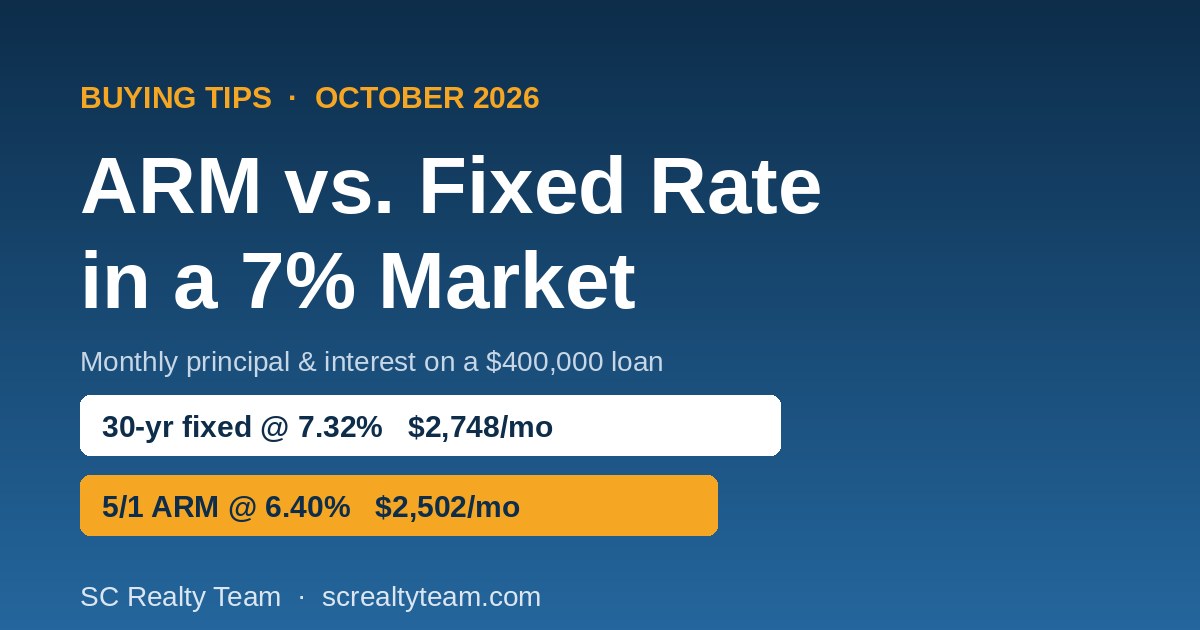
Mortgage rates have climbed back above 7%, and a lot of buyers I talk with are asking the same question: should I take an adjustable-rate mortgage to get a lower payment now, or lock in a fixed rate and stop worrying about it? There's no one right answer, but there is a right way to think it through.
Where rates stand right now
According to Freddie Mac's weekly survey, the average 30-year fixed rate was 7.32% for the week of October 22, 2026, with the 15-year fixed at 6.68%. That was a small dip from 7.40% the week before and the first weekly decline after a long run of increases, but rates are still roughly a full percentage point higher than they were a year ago.
Adjustable-rate mortgages are pricing lower. Bankrate's national averages this week show 5/1 ARM rates running roughly three-quarters of a point to a full point below the 30-year fixed. That gap is what makes ARMs worth a second look right now.
How each one works
Fixed-rate mortgage
- Your rate never changes for the life of the loan
- Principal & interest payment stays the same every month
- Higher starting rate than an ARM today
- If rates fall, you can refinance (at a cost)
Adjustable-rate (ARM)
- Lower fixed rate for an intro period, usually 5, 7, or 10 years
- After that, the rate adjusts based on a market index (usually SOFR) plus a set margin
- Caps limit how much it can rise at each adjustment and over the life of the loan
- Payment can go up or down after the intro period
A "5/1" ARM is fixed for five years and then adjusts once a year. A "5/6" ARM is fixed for five years and then adjusts every six months. A 7/1 or 10/1 gives you a longer fixed window, usually at a slightly higher starting rate.
What the difference looks like in real dollars
Here's a simple example on a $400,000 loan, principal and interest only (taxes, insurance and HOA are extra):
| Loan | Rate | Monthly P&I |
|---|---|---|
| 30-year fixed | 7.32% | $2,748 |
| 5/1 ARM (first 5 years) | 6.40% | $2,502 |
| Difference | $246/mo · about $14,700 over 5 years |
That's real money. But the question that matters is what happens in year six. After five years, the ARM balance would be about $374,000. Here's what the payment could look like depending on where the rate lands:
| ARM rate in year 6 | Monthly P&I | vs. the fixed loan |
|---|---|---|
| Stays at 6.40% | $2,502 | $246 less |
| Rises to 7.40% | $2,740 | About the same |
| Rises to 8.40% (+2 pts) | $2,986 | $238 more |
| Rises to 9.40% (+3 pts) | $3,242 | $494 more |
Example figures are illustrative and rounded. Your actual rate, caps, and payment depend on your lender, credit, down payment and loan program.
The bottom line: an ARM is a bet that you'll sell, refinance, or see rates come down before the fixed period ends. If that bet is wrong, your payment can go up meaningfully, so you need a plan, and a budget, for that scenario.
When an ARM can make sense
- You expect to move within 5–7 years. Military families at Fort Jackson, people relocating for work, or buyers purchasing a starter home often never reach the adjustment period.
- You're buying a higher-priced home where a lower rate makes a bigger dollar difference.
- Your income is likely to grow and you could comfortably handle a higher payment later.
- You plan to refinance if rates drop, and you could still afford the payment if they don't.
When a fixed rate is the safer call
- This is your long-term or forever home. Predictability is worth paying for.
- Your budget is already tight. If a $300–$500 payment increase would be a real problem, an ARM adds risk you don't need.
- You're on a fixed income or close to retirement.
- You don't want to watch rates. Peace of mind has value.
Questions to ask your lender before choosing an ARM
- How long is the fixed period, and how often does it adjust after that?
- What index is it tied to, and what is the margin?
- What are the caps? (Often written like 2/1/5 or 5/2/5: the first adjustment, each later adjustment, and the lifetime maximum.)
- What is the highest my payment could ever be?
- Is there a prepayment penalty if I refinance or sell?
Ask your lender to show you the worst-case payment in writing. If you can live with that number, an ARM may be a reasonable tool. If you can't, it probably isn't for you.
Other ways to lower your payment in this market
Ask the seller to help with a rate buydown
Instead of asking for a price cut, many buyers are negotiating seller credits that go toward buying down their rate, either permanently or with a temporary 2-1 buydown that lowers the rate for the first two years. Sellers are often open to it, and it can save you more each month than an equivalent price reduction.
Compare at least two or three lenders
Rates and fees vary more than most people realize. Getting a few Loan Estimates on the same day lets you compare apples to apples.
Look at the full monthly picture
Property taxes and insurance differ quite a bit between Richland, Lexington and Kershaw counties, and between neighborhoods with and without an HOA. Two homes at the same price can have very different monthly costs.
Be careful with "marry the house, date the rate"
Refinancing later can work, but it's not guaranteed. Rates may not fall when you want them to, and refinancing has closing costs. Buy a home whose payment works for you today.
Thinking about buying this year?
I can connect you with trusted local lenders and help you negotiate seller credits that lower your rate.
This article is for general information only and isn't financial or lending advice. Mortgage rates change daily. Talk with a licensed mortgage lender about your specific situation before choosing a loan.
Sources: Freddie Mac Primary Mortgage Market Survey (via Mortgage News Daily) · Bankrate 5/1 ARM rates